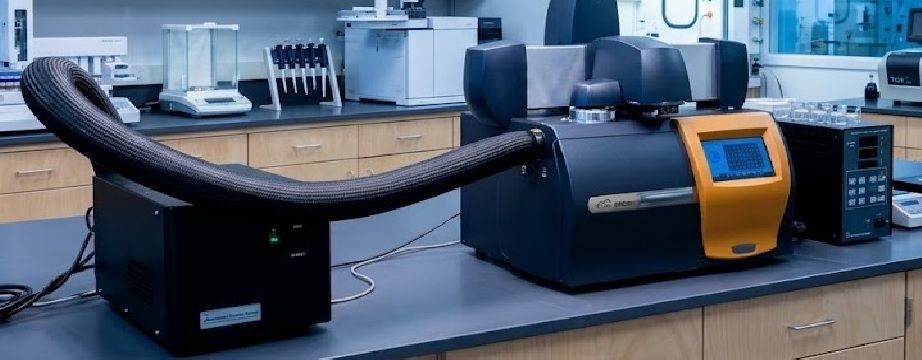
TMA Testing Services – Thermomechanical Analysis
Shanghai Jietuo Material Technology Co., Ltd. provides professional TMA (Thermomechanical Analysis) testing services for polymers, chemical materials, inorganic ceramic materials, metals, composites, fine chemicals, and biomaterials. Our services support material R&D engineers, university research teams, and industrial QA/QC departments in evaluating the thermomechanical properties of various materials.
By controlling the temperature according to a predefined program and applying a specified mechanical load, TMA measures changes in sample dimensions and deformation as a function of temperature or time. The technique provides essential material parameters, including the coefficient of thermal expansion (CTE), glass transition temperature (Tg), softening temperature, dimensional stability, and other thermomechanical characteristics.
Overview of TMA Testing Services
Thermomechanical Analysis (TMA) is a thermal analysis technique used to investigate the thermomechanical properties of materials by measuring dimensional changes under programmed temperature conditions and a specified mechanical load.
Shanghai Jietuo Material Technology Co., Ltd. provides TMA testing services for a wide range of material systems, with a particular focus on thermal expansion coefficients, glass transition temperatures, softening behavior, and dimensional stability under temperature variations.
| Test Item | Test Description | Main Applications and Benefits |
|---|---|---|
| Coefficient of Thermal Expansion (CTE) | Measures changes in sample length as a function of temperature | Evaluates thermal expansion behavior and dimensional compatibility between materials |
| Glass Transition Temperature (Tg) | Analyzes dimensional changes associated with the glass transition | Evaluates thermomechanical transitions in polymers and composites |
| Softening Temperature | Measures sample deformation under heating and probe loading | Evaluates thermal resistance and dimensional stability |
| Thermal Shrinkage and Expansion | Analyzes dimensional changes during heating | Investigates material processing and heat-treatment behavior |
| Thermal Expansion Anisotropy | Compares CTE values in different material directions | Evaluates PCB laminates, laminates, and fiber-reinforced composites |
| Temperature-Dependent Dimensional Changes | Records deformation-temperature curves | Supports material selection and failure analysis |
By providing quantitative relationships between dimensional changes and temperature, TMA delivers valuable data to support material formulation optimization, structural design, processing adjustments, and quality control.
What Is TMA (Thermomechanical Analysis)?
TMA (Thermomechanical Analysis) is a thermal analysis technique used to measure changes in the dimensions or deformation of materials as a function of temperature and time under a specified mechanical load.
During TMA testing, a sample is placed in the instrument's measurement system. Depending on the test configuration, different measurement modes, including expansion, compression, tension, bending, and penetration, can be employed. A predefined mechanical load is applied under programmed temperature conditions, while a high-sensitivity displacement detection system continuously records dimensional changes.
By analyzing deformation-temperature or deformation-time curves, key material properties can be determined, including the coefficient of thermal expansion, glass transition temperature, softening temperature, and dimensional stability.
Basic Principles of TMA Testing
The basic principle of TMA is to continuously measure dimensional changes in a sample under controlled temperature, mechanical load, and heating-rate conditions.
When heated, materials may undergo thermal expansion, thermal shrinkage, glass transition, softening, or other dimensional changes. TMA detects probe displacement and converts these changes into measurable thermomechanical response signals.
For linear thermal expansion measurements, the average linear coefficient of thermal expansion can be calculated using the following equation:
CTE = ΔL / (L₀ × ΔT)
Where:
- CTE: Average linear coefficient of thermal expansion.
- ΔL: Change in sample length over the selected temperature interval.
- L₀: Initial sample length at the reference temperature.
- ΔT: Temperature change over the selected interval.
CTE is typically expressed in ppm/°C or μm/(m·°C).
The thermal expansion coefficient may vary across different temperature intervals. Therefore, actual test results should be interpreted in consideration of the selected temperature range, sample condition, and applied mechanical load.
Main TMA Measurement Modes
| Measurement Mode | Principle | Typical Applications |
|---|---|---|
| Expansion Mode | Measures dimensional changes caused by temperature variations | CTE, Tg, and thermal expansion analysis |
| Compression Mode | Measures sample deformation under compressive probe loading | Softening behavior and compressive deformation |
| Penetration Mode | Measures probe penetration into a sample under a specified load | Softening temperature and localized thermomechanical behavior |
| Tension Mode | Measures dimensional changes under tensile loading | Films, fibers, and flexible materials |
| Bending Mode | Measures sample deformation under bending loads | Sheet materials and composites |
The available measurement modes depend on the instrument configuration, fixture availability, and sample geometry.
What Properties Can TMA Measure? Typical TMA Applications
TMA measures dimensional changes and thermomechanical responses of materials under temperature variations and mechanical loading. It is particularly useful for investigating thermal expansion behavior, dimensional stability, and thermomechanical transitions.
1. Coefficient of Thermal Expansion (CTE)
The coefficient of thermal expansion (CTE) is one of the most important parameters measured by TMA. It describes the extent to which a material changes in dimension when its temperature changes. Different materials exhibit different CTE values. When two materials with significantly different thermal expansion coefficients are joined together, temperature variations may generate thermal stresses, potentially leading to interfacial cracking, delamination, warpage, or connection failure. Typical Applications:
- CTE measurement in the X, Y, and Z directions of PCBs and copper-clad laminates.
- CTE testing of epoxy resins and electronic packaging materials.
- Thermal expansion compatibility studies of metal-ceramic bonding materials.
- Thermal expansion analysis of glass fiber-reinforced composites.
- Comparison of thermal expansion properties of adhesives before and after curing.
2. Glass Transition Temperature (Tg)
The glass transition temperature (Tg) is an important thermal property of polymer materials. As the temperature approaches the glass transition region, polymer chain segments gain increased mobility, resulting in significant changes in the material's thermomechanical response. TMA can identify the glass transition temperature by detecting changes in the slope of the material's thermal expansion curve. Typical Applications:
- Tg testing of cured epoxy resins.
- Tg analysis of PCBs and copper-clad laminates.
- Tg evaluation of resin matrices in composite materials.
- Tg testing of high-performance engineering plastics.
- Thermomechanical evaluation of adhesives and coating materials. For filled polymers, fiber-reinforced materials, or highly crosslinked systems, TMA may help identify weak thermomechanical transitions that are not easily detected by DSC. However, Tg values measured by TMA and DSC may differ because of their different measurement principles. Results obtained using different techniques should not be considered directly equivalent.
3. Softening Temperature
TMA monitors the deformation of materials under a specified mechanical load as the temperature increases, allowing their softening behavior to be evaluated. Typical Applications:
- Softening behavior analysis of thermoplastic polymers.
- Heat resistance evaluation of thermosetting resins and adhesives.
- Thermal deformation analysis of polymer films.
- Thermal stability studies of coatings and functional polymer materials. It should be noted that the softening temperature determined by TMA is different from the Vicat softening temperature and Heat Deflection Temperature (HDT). Results obtained using these different test methods should not be used interchangeably.
4. Thermal Expansion and Shrinkage Behavior
TMA records dimensional changes in materials during heating, cooling, and isothermal conditions. Typical Applications:
- Thermal shrinkage studies of polymer films.
- Dimensional change analysis of composite materials during heat treatment.
- Dimensional stability studies of cured epoxy resins.
- Thermal expansion and shrinkage analysis of ceramics before and after sintering.
5. Thermal Expansion Anisotropy
For fiber-reinforced composites, PCBs, laminates, and oriented polymers, thermal expansion coefficients may vary significantly in different directions. By testing samples prepared along different orientations, TMA can compare thermal expansion behavior in the X, Y, and Z directions. These results provide valuable information for material structural design and manufacturing process optimization.
6. Evaluation of Thermomechanical Stability
By comparing dimensional changes, deformation trends, and transition characteristics at different temperatures, TMA can be used to evaluate the thermomechanical stability of materials. Typical Applications:
- Performance comparison between new and existing material formulations.
- Quality comparison of raw materials from different suppliers.
- Evaluation of the effects of different curing conditions on resin properties.
- Batch-to-batch consistency assessment.
- Evaluation of material suitability for high-temperature processing and service environments.
What Materials Can Be Tested by TMA?
Shanghai Jietuo provides TMA testing services for a wide range of material systems, including polymers, chemical materials, inorganic ceramics, metals, composites, fine chemicals, and biomaterials.
| Material Category | Typical Materials | Main Test Items |
|---|---|---|
| Polymer Materials | PE, PP, PVC, PA, PC, PBT, PPS, PEEK | CTE, Tg, softening behavior, thermal shrinkage |
| Epoxy Resins | Bisphenol A epoxy, bisphenol F epoxy, novolac epoxy, cured epoxy systems | CTE, Tg, dimensional changes after curing |
| Adhesive Materials | Structural adhesives, electronic adhesives, thermal conductive adhesives, sealants | CTE, Tg, thermal dimensional stability |
| Electronic Materials | PCBs, copper-clad laminates, packaging materials, insulating materials | X/Y/Z-direction CTE, Tg |
| Composite Materials | Glass fiber composites, carbon fiber composites, resin-based composites | CTE anisotropy, Tg |
| Ceramic Materials | Alumina, zirconia, silicon nitride, ceramic matrix composites | Thermal expansion coefficient, dimensional changes |
| Metallic Materials | Aluminum, copper, steel, alloys, metal matrix composites | Thermal expansion coefficient, phase-transition-related dimensional changes |
| Glass Materials | Quartz glass, borosilicate glass, functional glass | CTE, softening-related dimensional changes |
| Coating Materials | Anti-corrosion coatings, functional coatings, polymer coatings | Thermal expansion, Tg, thermal dimensional stability |
| Films and Fibers | Polyimide films, PET films, functional fibers | Thermal shrinkage, CTE, thermomechanical response |
| Fine Chemicals and Biomaterials | Solid functional materials, polymer carriers, bio-based polymers | Determined according to sample state and testing objectives |
For powders, liquids, gels, highly adhesive samples, and irregularly shaped specimens, test feasibility must be evaluated according to sample morphology and testing objectives. Not all materials are suitable for conventional TMA expansion measurements.
Instrument Specifications
| Technical Parameter | Equipment Specification |
|---|---|
| Instrument Model | TA Instruments Q400 |
| Temperature Range | -70 to 550°C |
| Temperature Accuracy | ±0.01°C (value published on the original website; verification against instrument technical documentation and calibration records is recommended) |
| Heating Rate | 0.1–100°C/min |
| Measurement Technique | Thermomechanical Analysis (TMA) |
| Main Test Items | CTE, Tg, softening temperature, dimensional changes |
| Applicable Materials | Polymers, composites, ceramics, metals, electronic materials, etc. |
TMA Sample Requirements
To ensure the accuracy and reproducibility of TMA results, sample dimensions, surface flatness, internal structure, and sample condition must meet the requirements of the selected measurement mode. Before submitting samples, Shanghai Jietuo recommends providing the sample name, material composition, dimensions, testing objectives, and expected temperature range. Our technical team can then evaluate the appropriate testing conditions.
1. Standard Solid Samples for Expansion Testing
| Sample Geometry | Recommended Dimensions |
|---|---|
| Rectangular Solid Samples | Length: 5–10 mm; Width: 5–10 mm; Thickness: 1–4 mm |
| Cylindrical Solid Samples | Diameter: 5–10 mm; Thickness: 1–4 mm |
2. Samples for Multi-Directional Thermal Expansion Testing
| Sample Geometry | Recommended Dimensions |
|---|---|
| Rectangular Solid Samples | Length: 5–10 mm; Width: 5–10 mm; Thickness: 5–10 mm |
For multi-directional testing, customers are advised to clearly identify the X, Y, and Z directions and sample orientation, and provide necessary machining-direction markings.
3. Thin Film Samples for Tension Testing
| Parameter | Recommended Dimensions |
|---|---|
| Length | 20–50 mm |
| Width | 2–3.5 mm |
| Thickness | 0.05–0.5 mm |
4. Sample Surface and Condition Requirements
- Sample surfaces should be as flat and smooth as possible to ensure proper contact with the probe or supporting components.
- Solid samples should be free from obvious internal pores, cracks, and structural defects whenever possible.
- Samples should exhibit good homogeneity and dimensional stability.
- If the sample surface is uneven, appropriate surface polishing using 400-grit sandpaper may be considered, depending on the sample characteristics.
- Before testing, customers should specify whether the samples have undergone curing, annealing, drying, heat treatment, or other processing procedures.
- Hygroscopic, volatile, thermally decomposable, or oxidation-sensitive samples should be identified to the technical team in advance.
5. Recommended Sample Quantity
Customers are advised to provide sufficient sample quantities according to the sample dimensions and required test items. For tests involving different material orientations, multiple temperature intervals, or repeatability assessments, additional samples may be required. Please confirm the required sample quantity with our technical team before shipment.
TMA Testing Procedure

TMA Testing Standards
| Standard Number | Standard Title | Main Test Scope |
|---|---|---|
| ISO 11359-1:2014 | Plastics — Thermomechanical Analysis (TMA) — Part 1: General Principles | Basic TMA principles and general testing requirements |
| ISO 11359-2:2021 | Plastics — Thermomechanical Analysis (TMA) — Part 2: Determination of Coefficient of Linear Thermal Expansion and Glass Transition Temperature | Linear thermal expansion coefficient and Tg determination |
| ISO 11359-3:2019 | Plastics — Thermomechanical Analysis (TMA) — Part 3: Determination of Penetration Temperature | Penetration temperature determination |
| ASTM E831-25 | Standard Test Method for Linear Thermal Expansion of Solid Materials by Thermomechanical Analysis | Linear thermal expansion coefficient testing of solid materials |
| ASTM E1545-22 | Standard Test Method for Assignment of the Glass Transition Temperature by Thermomechanical Analysis | Glass transition temperature determination using TMA |
| IEC 61189-2-805:2024 | Test Methods for Electrical Materials, Printed Boards and Other Interconnection Structures and Assemblies — Part 2-805 | CTE testing in the X/Y directions of thin substrates |
How Does TMA Compare with Other Thermal Analysis Techniques?
TMA, DSC, TGA, and DMA are commonly used material analysis techniques. However, they differ in measurement principles and the properties they characterize. For material R&D engineers, selecting the appropriate analytical technique helps obtain more meaningful information about thermal properties, mechanical behavior, and structural changes.
TMA vs. DSC
| Comparison Item | TMA (Thermomechanical Analysis) | DSC (Differential Scanning Calorimetry) |
|---|---|---|
| Measurement Principle | Measures dimensional or deformation changes under mechanical loading | Measures the heat flow difference between a sample and a reference |
| Primary Data | Displacement, dimensional changes, CTE | Heat flow, enthalpy changes, thermal transition peaks |
| Main Test Items | CTE, Tg, softening behavior | Tg, melting temperature, crystallization temperature, curing reactions |
| Typical Applications | Dimensional stability and thermal expansion compatibility | Thermal transitions, phase changes, and reaction heat analysis |
| Applicable Materials | Polymers, composites, ceramics, metals, etc. | Polymers, chemical materials, metals, and other materials |
How Should You Choose Between TMA and DSC? If you need to determine a material's coefficient of thermal expansion, dimensional changes, thermal shrinkage, or softening behavior, TMA is generally the preferred technique. If you need to investigate melting, crystallization, glass transition-related heat effects, or curing exotherms, DSC is more appropriate. For certain complex material systems, TMA and DSC can be used together to provide complementary information from both dimensional-change and heat-flow perspectives.
TMA vs. TGA
| Comparison Item | TMA | TGA (Thermogravimetric Analysis) |
|---|---|---|
| Measurement Target | Material dimensions and deformation | Material mass |
| Primary Data | Displacement-temperature curve | Mass-temperature curve |
| Main Test Items | CTE, Tg, softening behavior | Thermal decomposition, mass loss, residual mass |
| Typical Applications | Thermal dimensional stability | Thermal stability, volatile components, and decomposition behavior |
TMA vs. DMA
| Comparison Item | TMA | DMA (Dynamic Mechanical Analysis) |
|---|---|---|
| Measurement Principle | Measures dimensional changes and deformation caused by temperature or time variations | Measures viscoelastic responses under oscillatory mechanical loading |
| Primary Data | Displacement, CTE, dimensional changes | Storage modulus (E'), loss modulus (E''), tan δ |
| Main Applications | Thermal expansion and dimensional stability | Viscoelasticity, damping, and mechanical transitions |
| Typical Materials | PCBs, ceramics, composites, epoxy resins | Rubber, damping materials, adhesives, polymers |
If your objective is to measure damping characteristics, loss factor (tan δ), storage modulus, or loss modulus, DMA is generally the appropriate technique rather than TMA.
Three Typical TMA Testing Case Studies
The following case studies illustrate typical material R&D scenarios and demonstrate how TMA testing can be applied. They are representative application examples rather than actual completed customer projects. No unverified experimental results are included. For formal publication, these examples can gradually be replaced with anonymized customer projects and actual test curves obtained by Shanghai Jietuo.
Case Study 1: CTE and Tg Testing of PCB Copper-Clad Laminates
1. Test Sample
Glass fiber-reinforced epoxy copper-clad laminate (FR-4 PCB substrate).
2. Testing Objectives
To evaluate the thermal expansion behavior of PCB substrate materials during heating, determine the CTE values before and after the glass transition temperature, and investigate Z-axis thermal expansion characteristics. The results provide supporting data for PCB thermal reliability assessment and soldering process evaluation.
3. Testing Method
TMA expansion mode is used to conduct programmed heating tests on PCB substrate samples. Samples are prepared in the X/Y and Z directions according to customer requirements to measure dimensional changes along different orientations. The sample displacement is continuously recorded as a function of temperature.
4. Dynamic Heating Test Conditions
The following are illustrative testing conditions. Final parameters should be determined according to the sample characteristics and applicable testing standards.
- Measurement Mode: Expansion.
- Test Atmosphere: Nitrogen or another confirmed suitable atmosphere.
- Reference Heating Rate: 5°C/min.
- Temperature Range: Room temperature to 200°C, with the upper limit adjusted according to the material and instrument conditions.
- Applied Load: Set according to sample stiffness and applicable standard requirements.
5. Data and Curves Obtained
- TMA displacement-temperature curve.
- Linear CTE below Tg.
- Linear CTE above Tg.
- Glass transition temperature (Tg).
- Comparison of CTE values in the X, Y, and Z directions.
- Analysis of thermal expansion anisotropy in PCB substrates.
6. Testing Value
By comparing the CTE and Tg values of PCB substrates in different directions, material dimensional stability under temperature variations can be evaluated. The results provide supporting data for reducing thermal stress, warpage, and the risk of PCB delamination or blistering during thermal processing.
Case Study 2: CTE and Glass Transition Temperature Testing of Cured Epoxy Resin
1. Test Sample
A thermosetting epoxy resin cured using a bisphenol A epoxy resin and an amine-based curing agent.
2. Testing Objectives
To investigate the effects of different epoxy resin formulations and curing processes on the CTE and glass transition temperature of cured materials. The results support formulation optimization of electronic adhesives, structural adhesives, potting compounds, and resin systems used in composite materials.
3. Testing Method
Fully cured epoxy resin samples are prepared as solid specimens with specified dimensions. TMA expansion mode is then used to conduct dynamic heating tests. By analyzing changes in the slope of the TMA curve, the CTE values before and after the glass transition and the Tg can be determined.
4. Dynamic Heating Test Conditions
Illustrative testing conditions:
- Measurement Mode: Expansion.
- Test Atmosphere: Nitrogen.
- Reference Heating Rate: 5°C/min.
- Temperature Range: Room temperature to 200°C, depending on the thermal resistance of the resin system.
- Applied Load: Set according to sample stiffness and testing requirements.
5. Data and Curves Obtained
- Displacement-temperature curve of the cured epoxy resin.
- Glass transition temperature (Tg).
- CTE below Tg.
- CTE above Tg.
- CTE comparison among different epoxy resin formulations.
- Evaluation of the effects of different curing processes on thermomechanical properties.
6. Testing Value
By comparing TMA results from different epoxy resin formulations and curing conditions, the effects of resin crosslinking structures and curing processes on dimensional stability can be investigated. The results provide valuable information for epoxy resin formulation design and material selection.
Case Study 3: Thermal Expansion Coefficient Testing of Ceramic Materials
1. Test Sample
Alumina ceramic or other dense ceramic materials suitable for TMA testing.
2. Testing Objectives
To measure the linear thermal expansion coefficient of ceramic materials during heating and investigate dimensional changes across different temperature intervals. The results support ceramic material selection, metal-ceramic joining, and thermal matching design.
3. Testing Method
Ceramic samples are machined into uniform specimens with flat surfaces. TMA expansion mode is used to conduct programmed heating tests. The dimensional changes of the samples are recorded as a function of temperature, and the average linear thermal expansion coefficients are calculated over selected temperature intervals.
4. Dynamic Heating Test Conditions
Illustrative testing conditions:
- Measurement Mode: Expansion.
- Test Atmosphere: Air or an inert atmosphere, depending on the material characteristics.
- Reference Heating Rate: 5°C/min.
- Temperature Range: Room temperature to 500°C, subject to sample characteristics, instrument limitations, and applicable testing standards.
- Applied Load: Set according to sample stiffness and applicable testing requirements.
5. Data and Curves Obtained
- Displacement-temperature curve of ceramic materials.
- Linear thermal expansion coefficients over different temperature intervals.
- Average thermal expansion coefficient.
- Thermal expansion curves and temperature-dependent variations.
- CTE comparison among different ceramic materials.
6. Testing Value
By determining the thermal expansion coefficients of ceramic materials, their dimensional changes under different temperature conditions can be evaluated. The results provide fundamental data for metal-ceramic joining, ceramic packaging, and the design of high-temperature structural materials.
Frequently Asked Questions (FAQ)
Q1: What Parameters Can Be Measured by TMA?
TMA is primarily used to measure dimensional changes and thermomechanical responses of materials under programmed temperature conditions and a specified mechanical load. The main measurable parameters include:
- Coefficient of Thermal Expansion (CTE).
- Glass Transition Temperature (Tg).
- Softening temperature.
- Thermal expansion and shrinkage behavior.
- Thermal expansion coefficients in different directions.
- Temperature-dependent dimensional stability. The actual parameters that can be obtained depend on the material, sample geometry, measurement mode, and testing conditions.
Q2: What Is the Difference Between TMA and DSC? How Should I Choose?
The main difference between TMA and DSC lies in their measurement signals and principles. TMA measures dimensional or deformation changes under mechanical loading. It is suitable for CTE determination, dimensional stability evaluation, and thermomechanical transition analysis. DSC measures the heat flow difference between a sample and a reference. It is suitable for investigating glass transition-related thermal effects, melting, crystallization, and curing reactions. If you need to measure a material's coefficient of thermal expansion, TMA is recommended. If you need to determine melting peaks, crystallization peaks, or curing exotherms, DSC is the more appropriate technique.
Q3: How Much Sample Is Required for TMA Testing? What Are the Sample Size Requirements?
TMA sample dimensions depend on the selected measurement mode and fixture requirements. According to the sample preparation recommendations currently published on the Jietuo website:
- Standard rectangular samples: 5–10 mm × 5–10 mm × 1–4 mm.
- Cylindrical samples: Diameter 5–10 mm; thickness 1–4 mm.
- Multi-directional testing samples: Rectangular specimens with dimensions of approximately 5–10 mm.
- Thin film samples for tension testing: Length 20–50 mm, width 2–3.5 mm, and thickness 0.05–0.5 mm. Sample surfaces should be as flat as possible, and obvious internal pores or cracks should be avoided. For special sample types, customers are advised to contact our technical team in advance to confirm sample dimensions and required quantities.
Q4: Can TMA Measure the CTE and Tg of Epoxy Resins, PCBs, and Composite Materials?
Yes. However, the appropriate measurement mode should be selected according to the sample structure and testing objectives. For cured epoxy resins, TMA can measure the CTE values before and after the glass transition and determine Tg. For PCBs and copper-clad laminates, thermal expansion behavior can be evaluated in different directions, particularly along the Z-axis. For fiber-reinforced composites, TMA can compare thermal expansion behavior in different directions and investigate material anisotropy. For filled polymers and highly crosslinked materials, TMA may also help identify certain thermomechanical transitions that are difficult to detect using DSC alone.
Q5: What TMA Testing Reports Does Shanghai Jietuo Provide? How Can I Request a Test?
Shanghai Jietuo Material Technology Co., Ltd. provides professional TMA testing services for evaluating the thermomechanical properties of materials.